

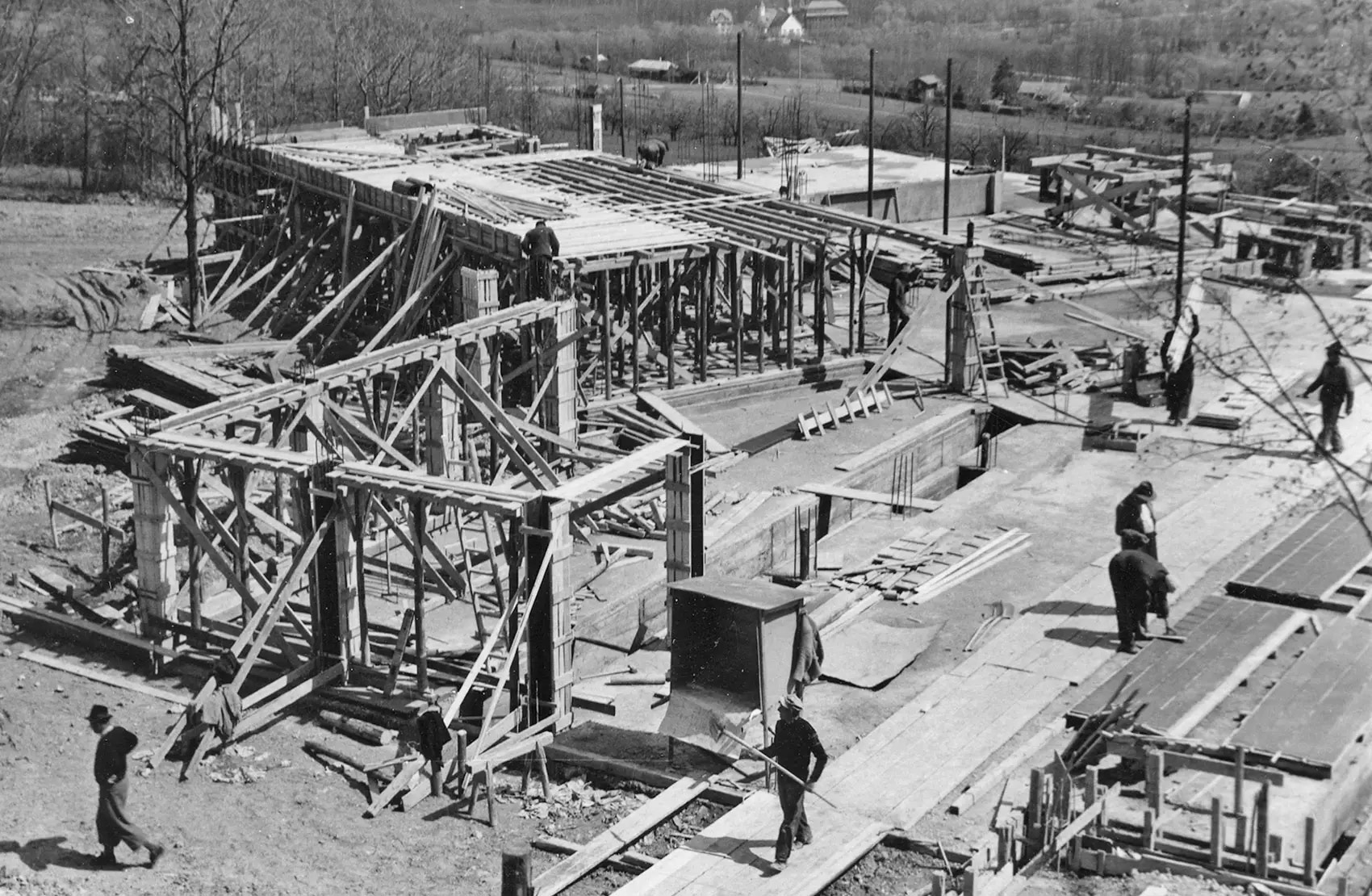
Construction site, photographer: unknown, © HfG Archive / Museum Ulm, reference number: HfG Archive
Foundation Assets
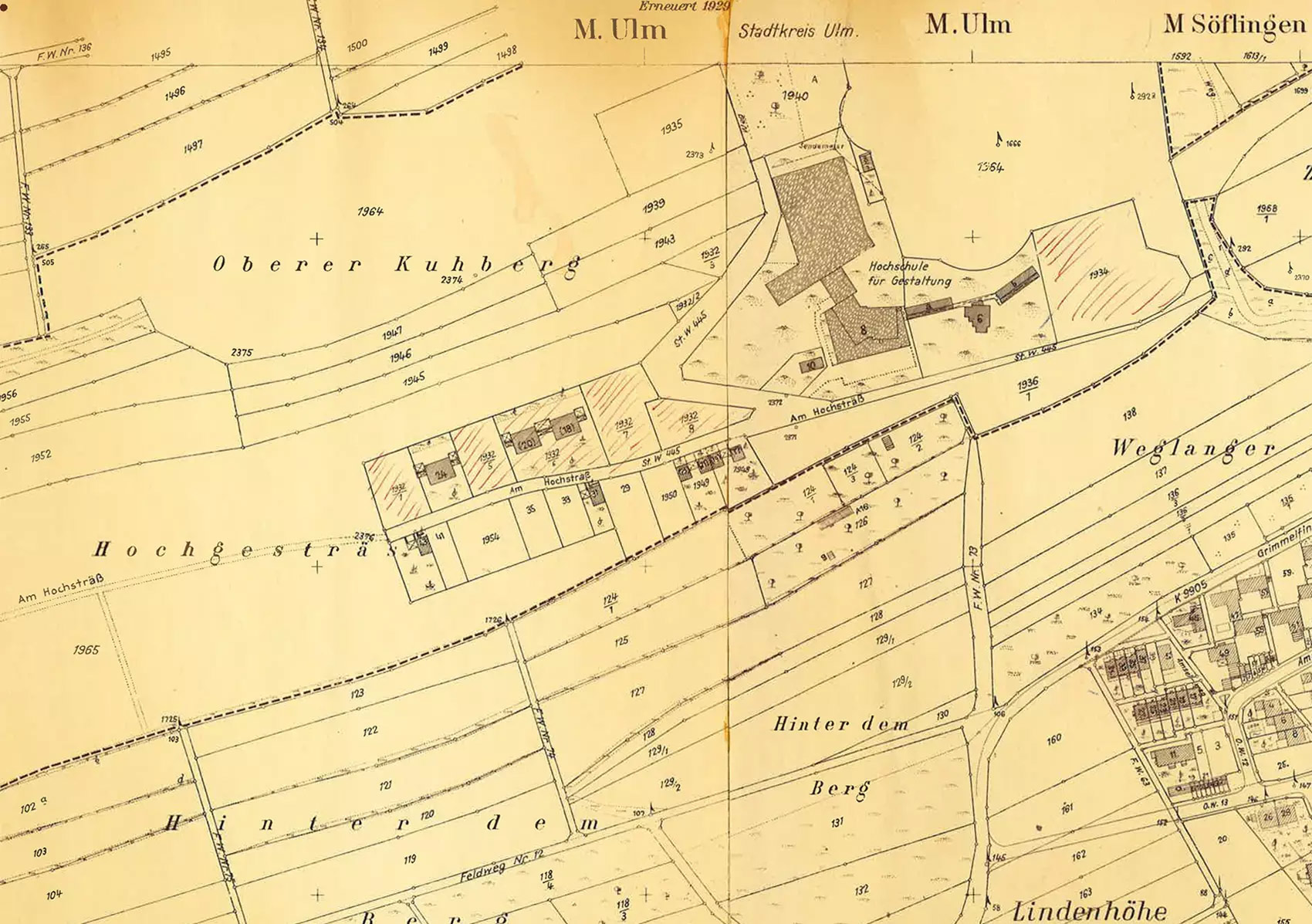
The assets of the HfG Ulm Foundation consist of the HfG Ulm’s properties. The original campus complex on Ulmer Hochsträß, built between 1953 and 1955, comprises the university building, including the gatehouse, as well as various residential units, to which further units were added in the 1980s.The buildings of the HfG Ulm and their history
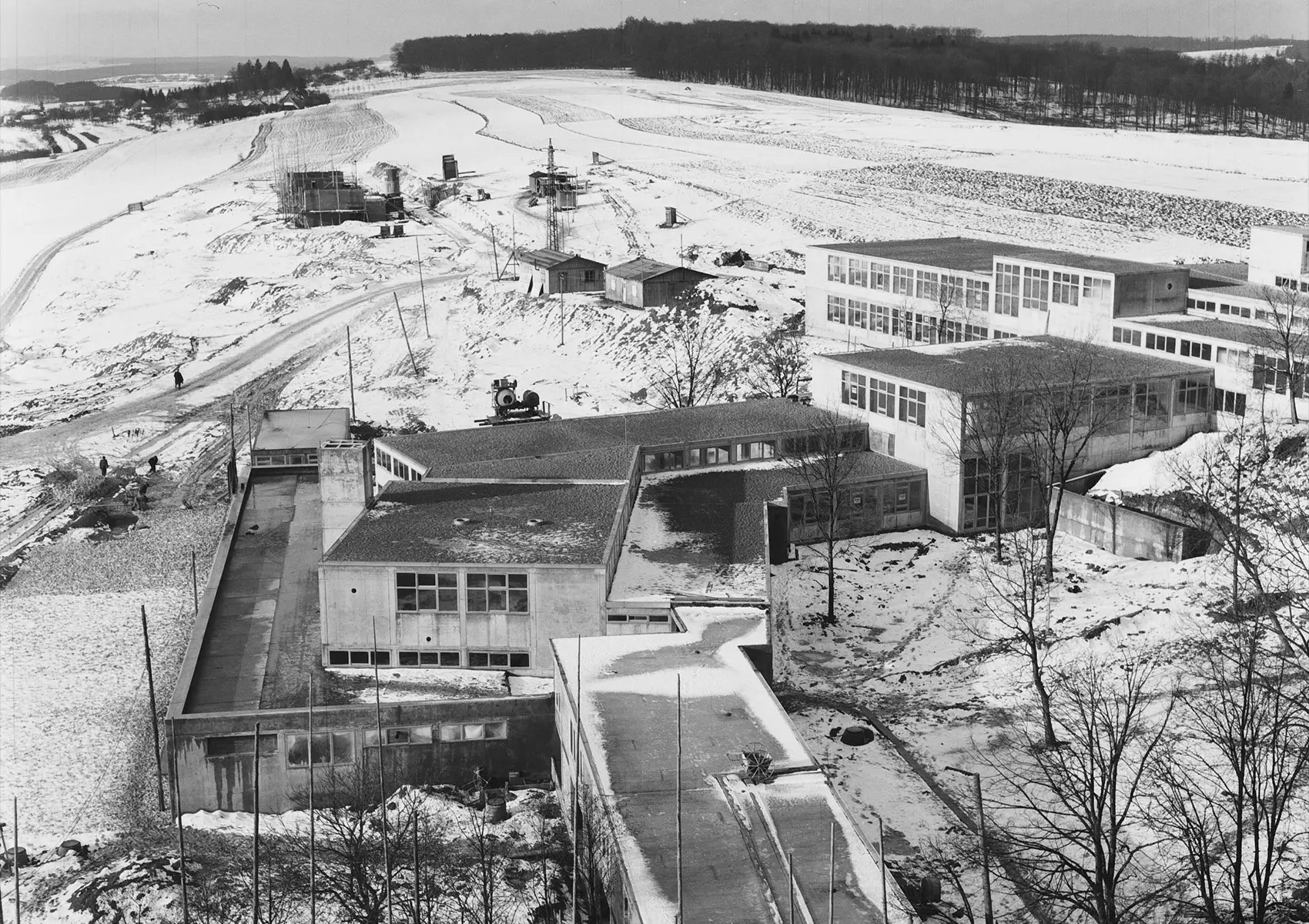
Construction site, photographer: R. Lauhus, © HfG Archive / Museum Ulm, reference number: HfG Archive
Purpose of the Foundation
The work of the Foundation is based on the purpose set out in its Articles of Association as follows.‘… The purpose of the Foundation is to promote scholarship, research and development in the field of design, as well as the preservation of historic buildings. At the heart of its charitable work lie:
- The recognition of cultural change and the continuous promotion of this development both internally (among designers) and externally (the public).
- Safeguarding the historical development of the HfG/IFG (since 1950) as a basis for fundamental research.
- The preservation of the Foundation’s own building complex on the Oberer Kuhberg in Ulm as a cultural monument of the State of Baden-Württemberg. …'
Listed Building Protection and Building Maintenance
The HfG Ulm campus has been a listed building since 1979. The Tübingen Regional Council, as the higher authority responsible for listed buildings, states the following in its order of 14 December 1983 regarding the entire complex ‘Former Ulm University of Design on the Danube’ (excerpt):‘Pursuant to Section 19 of the Heritage Protection Act of 25 May 1971, it is hereby decreed in agreement with the City of Ulm:
Section 1
1. The described area of the city of Ulm on the Danube is placed under the protection of the Heritage Protection Act as the ‘Former Ulm School of Design’ complex.
2. The appearance of the former Ulm School of Design, planned and built between 1950 and 1955 and regarded as a landmark of post-war architecture, is protected. The appearance is characterised by the buildings’ distinctive integration into the slopes of the Oberer Kuhberg, as well as by a restrained, grid-based layout of the structures and a deliberate restriction of building materials to exposed concrete and timber. …’
© Stiftung Hochschule für Gestaltung HfG Ulm
Ensemble Heritage Protection
The entire complex is protected as an ensemble under Section 2 of the Baden-Württemberg Heritage Protection Act (DSchG BW). In the Baden-Württemberg Heritage Protection Act (DSchG), an ‘ensemble’ – often referred to as an ‘entire complex’ – denotes a group of built structures whose preservation is in the public interest due to their historical, artistic or urban planning significance. Overall heritage value: Not every individual building within an ensemble needs to be a listed building. The protection relates to the harmonious interplay of several buildings, housing estates, streetscapes, squares or green spaces.Individual listed building
Within the overall ensemble, the original buildings from the era of the Ulm School of Design (HfG Ulm) are subject to special protection; these are designated as individual listed buildings in accordance with Section 12 of the Baden-Württemberg Heritage Protection Act (DSchG BW), such as the former university building. It is therefore a cultural monument in which there is a public interest in its preservation for scientific, artistic or historical reasons. As a rule, the entire building is protected – that is, both the exterior and the interior, and in some cases even the fixtures and fittings.
Building maintenance presents the HfG Ulm Foundation with constant challenges in preserving its assets, given the conditions and reasons outlined above. The aim is to carry out building works in a way that ensures the property is used in a contemporary manner, whilst carefully and thoughtfully observing all the relevant conditions. All measures are carried out in close consultation with the City of Ulm’s local heritage authority and, where necessary, with the Tübingen State Heritage Office.